01 · An overview
The license follows the material.
There is no single license prescribed for a Buddhist website. Dharma uses the MIT License for its software and CC BY-NC 4.0 for original teaching contributions where the contributors hold rights. Imported works retain their own terms. No project license expands somebody else's permissions or restricts material already in the public domain.
| Material | License / status | Credit & details |
|---|---|---|
| Ancient Pāli root text | Public domain; SuttaCentral-created contributions CC0 unless otherwise specified | Mahāsaṅgīti edition via SuttaCentral |
| English translation | CC BY-NC 4.0 | © 1998 Thanissaro Bhikkhu; Access to Insight, 2013 edition |
| Nepali & Hindi drafts, editorial explanations, alignment annotations and captions | CC BY-NC 4.0, only to the extent contributors hold rights | Dharma contributors; AI drafts awaiting validation |
| Three interpretive illustrations | CC BY-NC 4.0, only to the extent project rights exist | AI-generated for Dharma; illustrative interpretations |
| Noto Serif & Noto Serif Devanagari fonts | SIL Open Font License 1.1 | Five files across two families; The Noto Project Authors / Google; file-specific notices below |
| Project-authored website software | MIT License | © 2026 Sameer Regmi and Dharma contributors; scope and third-party tools |
| PDFs and printouts | Each included component retains its terms | Selected languages and optional illustrations, with credits |
02 · English source
Thanissaro Bhikkhu's translation
Cula-Malunkyovada Sutta: The Shorter Instructions to Malunkya (MN 63), translated from the Pāli by Thanissaro Bhikkhu. © 1998 Thanissaro Bhikkhu. Access to Insight (BCBS Edition), revised 30 November 2013.
The source identifies this translation as Creative Commons Attribution-NonCommercial 4.0 International (CC BY-NC 4.0). It may be shared and adapted for noncommercial purposes under that license, with appropriate attribution, a license link, retained notices and an indication of changes. No endorsement by the translator, Access to Insight or BCBS is implied.
Changes in Dharma: the English wording is preserved. HTML presentation and whitespace were normalized; the text was divided into 28 reading passages and semantic alignment groups for parallel navigation. This presentation does not represent a new translation by Thanissaro Bhikkhu. The ATI source points readers to a later edition elsewhere; the current reader uses the specified ATI edition.
03 · Root text
Pāli in Roman and Devanagari scripts
The ancient Pāli text of Cūḷamāluṅkyasutta (MN 63), Mahāsaṅgīti edition, is in the public domain. It was obtained from SuttaCentral's Bilara data. SuttaCentral-created contributions are generally dedicated under CC0 unless otherwise noted. This does not place every translation or legacy work hosted by SuttaCentral under CC0.
Changes in Dharma: the Roman-script Pāli is retained in the data. Devanagari is a mechanical transliteration for reading, not a new critical edition: both ṃ and ṁ map to anusvāra, ḷ maps to ळ, and source punctuation is retained. The 179 source segment identifiers are mapped to 28 reading passages; project alignment annotations are distinguished from the ancient text.
Dharma adds no restriction to the public-domain Pāli. Credit to SuttaCentral identifies the edition and data source; it is not a claim that SuttaCentral endorses this reader or its translations.
04 · Project teaching content
Nepali & Hindi: drafts for review
The current Nepali and Hindi texts are AI-generated, unvalidated drafts, prepared using the Pāli and consultation of the ATI English edition. The planned process is owner editing and validation followed by expert language review. A draft label is not a claim of scholarly accuracy; future reviewed editions must identify their reviewer and revision history.
To the extent contributors hold copyright or similar rights, original Nepali/Hindi contributions, editorial introductions, glossary explanations, alignment annotations, captions and later editorial revisions are offered under CC BY-NC 4.0. Where a contribution is an adaptation of the ATI English translation, its source credit and noncommercial terms continue to apply.
No copyright or exclusive rights are asserted over the ancient teachings, facts, public-domain material or AI-generated output to the extent it is not legally protectable. This license grants only rights the project can actually grant. Editing a text does not imply approval by its source translator or institutions.
Suggested project credit
Dharma contributors, Dharma sutta reading project, MN 63, [language and edition], AI draft / [review status], CC BY-NC 4.0. Changes: [describe changes]. Retain the supplied ATI source credit where applicable.
05 · Visual interpretations
Illustrations made for this edition
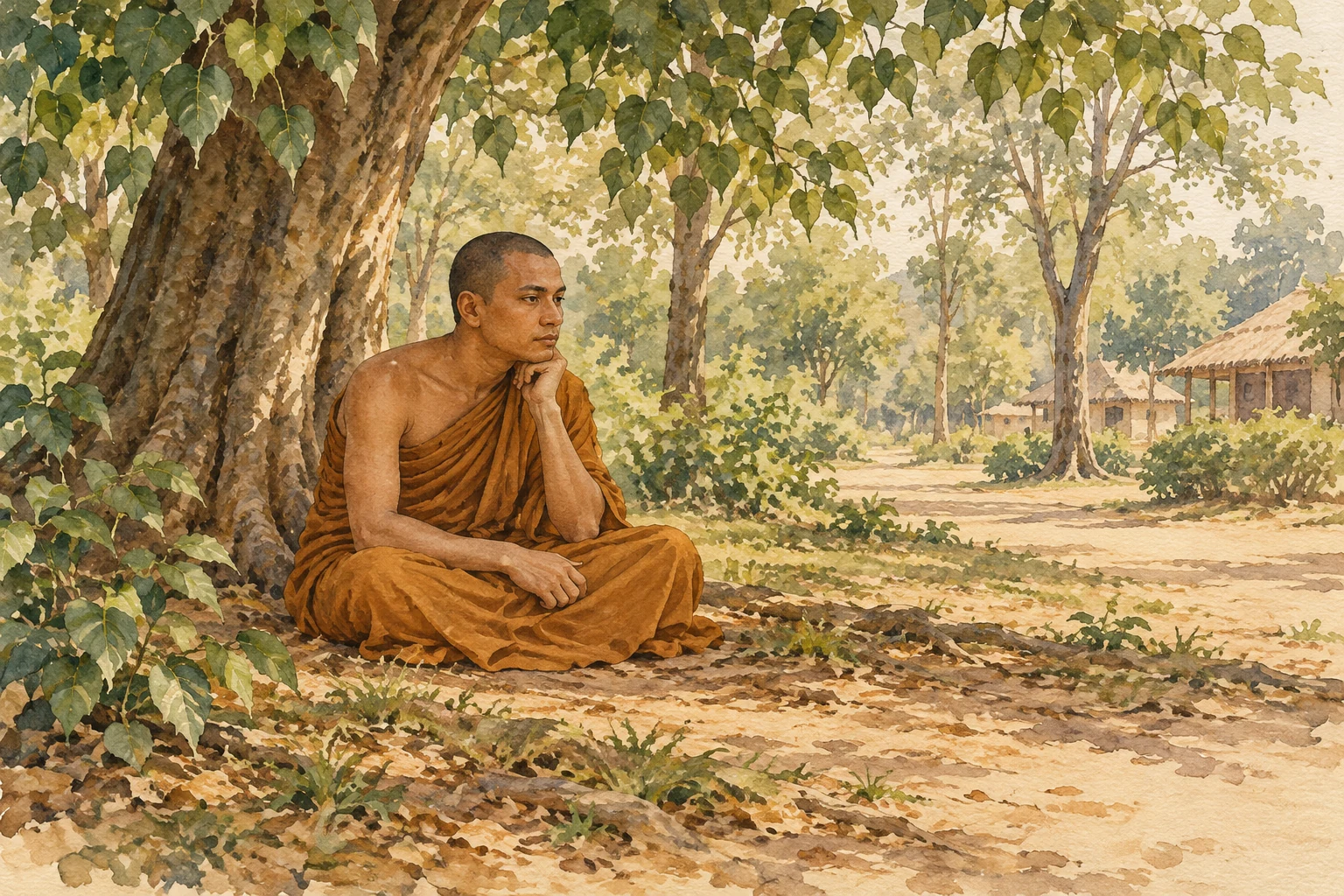
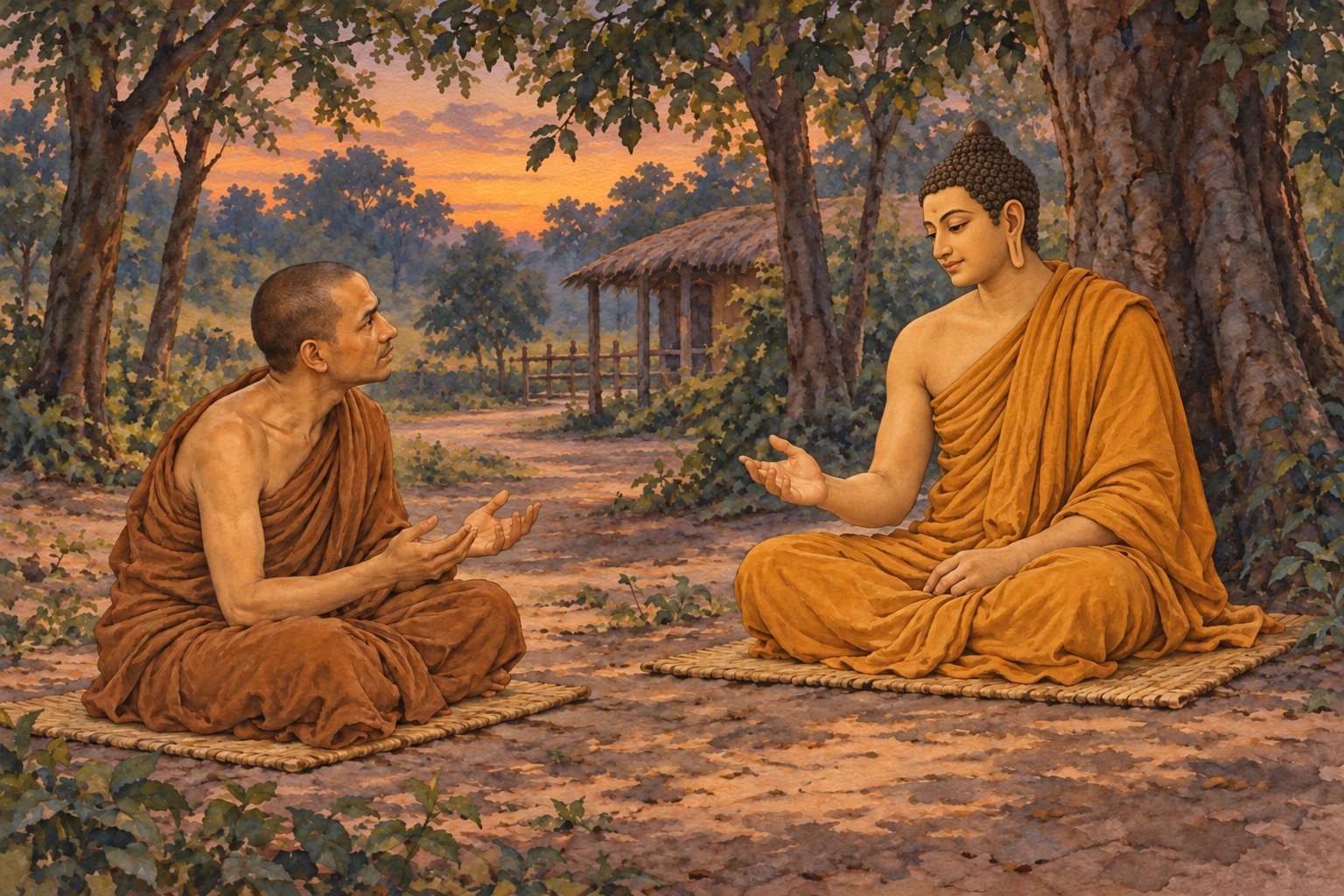
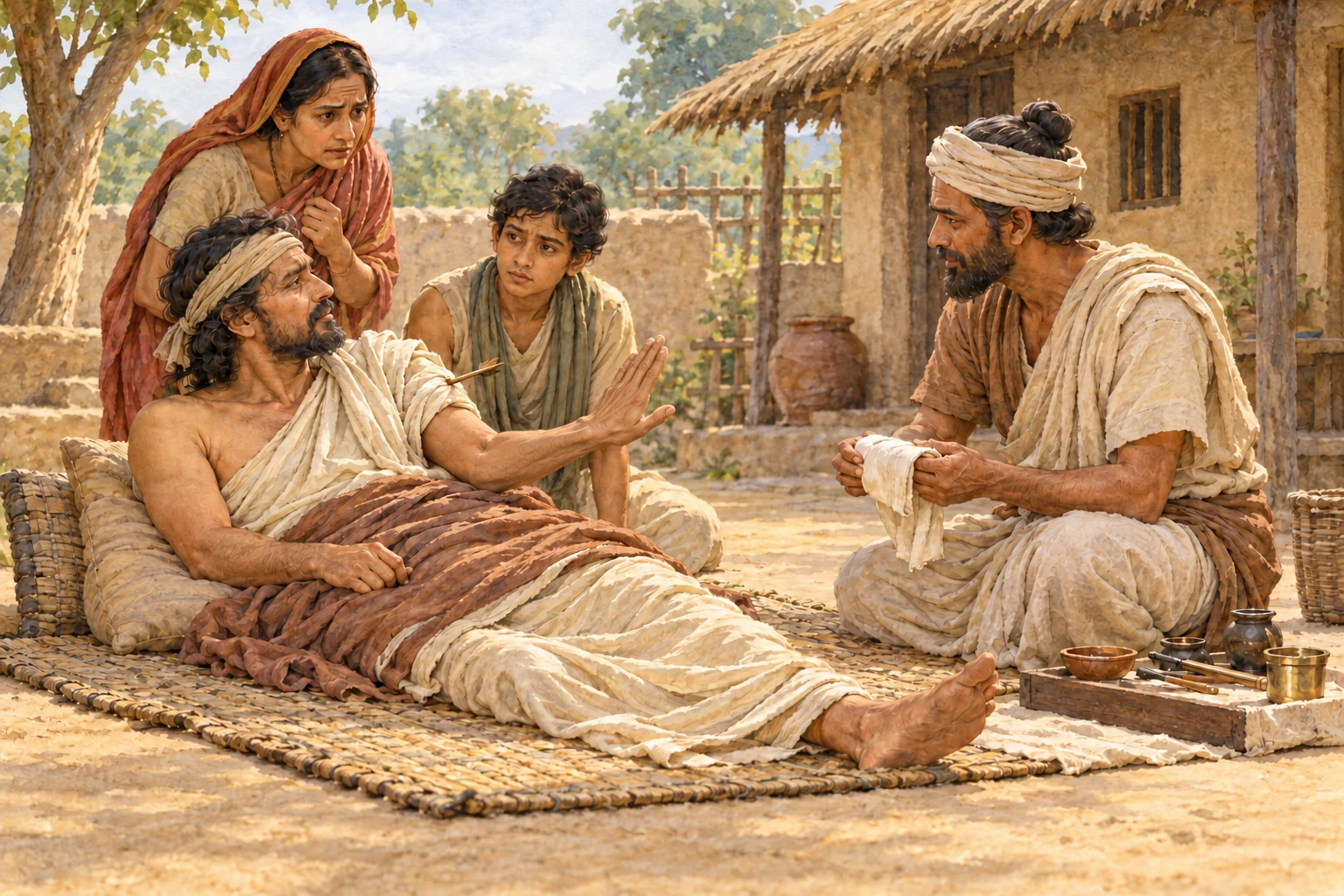
The three illustrations were created with OpenAI's built-in image-generation tool on 29 October 2026 for this project. They are AI-generated watercolor-style interpretations, not historical photographs, archaeological reconstructions or verified likenesses. No external stock image is incorporated as a reference in their recorded generation prompts.
| Image | Text anchor | Depicted scene |
|---|---|---|
| Seclusion01-seclusion.png / .webp / -thumb.webp | mn63-002 | Māluṅkyaputta alone in contemplation. His precise tree, seated pose and visual appearance are artistic choices. |
| Evening conversation02-conversation.png / .webp / -thumb.webp | mn63-005Source mn63:3.1 | Māluṅkyaputta speaking with the Buddha in the evening. The lighting and traditional artistic Buddha depiction were corrected; people's appearances and setting details are interpretations. |
| Poisoned-arrow simile03-arrow-simile.png / .webp / -thumb.webp | mn63-012 | The hypothetical injured man, surgeon and concerned family. This is a simile told by the Buddha, not an event in the Buddha's life; the Buddha is not depicted in this image. |
PNG masters are retained at 1536 × 1024 pixels. Sharp was used to encode full-size WebP delivery copies and thumbnails; compression does not change scene composition. The artwork provenance and full prompt record documents generation, the 30 October 2026 Buddha-depiction and hand-anatomy edits, delivery settings and visual review.
Project-held rights, if any, in these illustrations and their captions are offered under CC BY-NC 4.0. The project does not assert exclusive copyright over unprotectable AI output or guarantee that generated material is unique. When sharing the images, retain their AI/interpretive label, source-scene distinction and supplied credit.
Suggested illustration credit
Dharma contributors, “[scene title],” interpretive AI illustration for MN 63, 29 October 2026. CC BY-NC 4.0 to the extent project rights exist. Changes: [describe changes].
06 · Typography
Noto Serif & Noto Serif Devanagari
The five bundled font files across these two families use the SIL Open Font License, Version 1.1. Noto Serif covers Latin text; Noto Serif Devanagari covers the Pāli, Nepali and Hindi scripts. They are third-party fonts, not project-owned or covered by the project's MIT license. Preserve their copyright and OFL notices when redistributing font files, and follow the OFL's font-distribution, reserved-name and modification terms.
| Bundled file & use | Copyright notice | Upstream & preserved terms |
|---|---|---|
noto-serif-devanagari.ttfVariable font · website | Copyright 2022 The Noto Project Authors (notofonts/devanagari) | Google Fonts source OFL with the variable-font notice |
noto-serif-devanagari-regular.ttfnoto-serif-devanagari-medium.ttfStatic fonts · PDF generation | Binary notices: Copyright 2019 Google Inc. All Rights Reserved. Preserved upstream license header: Copyright 2018 The Noto Project Authors (github.com/googlei18n/noto-fonts). | Noto static font source Upstream static-font OFL and notice |
noto-serif-regular.ttfnoto-serif-bold.ttfStatic Latin fonts · PDF generation, self-hosted text and printing | Binary notices: Copyright 2015-2021 Google LLC. All Rights Reserved. Preserved upstream license header: Copyright 2018 The Noto Project Authors (github.com/googlei18n/noto-fonts). | Noto Serif static font source Upstream static-font OFL and notice |
The “All Rights Reserved” copyright notices identify the owners; the accompanying OFL provides the permission to use and distribute the static fonts. The file-specific binary notices and repository license notice are retained together. The font source record and detailed font notices and checksums map files to their origins.
Downloaded PDFs and native print styles use the bundled OFL families for both Latin and Devanagari text, including page furniture. Embedding these fonts in a PDF does not place the document's text or illustrations under the OFL. Any CSS references to Georgia, Times New Roman or Nirmala UI are device-font fallbacks; those proprietary font files are not distributed by this project.
07 · Code & tools
Open-source reader software
Copyright © 2026 Sameer Regmi and Dharma contributors. Project-authored application code, styles, build and verification scripts, tests and developer documentation use the MIT License, except separately identified teaching content, artwork, fonts and third-party material. The MIT software permission allows commercial use, modification and redistribution while retaining its copyright and license notice, and provides no warranty.
Read the complete MIT text and project scope. A repository containing MIT software does not make every text, illustration, font or PDF in that repository MIT-licensed.
Third-party development and authoring tools
The exact dependency inventory and original copyright/license texts are retained in Third-party software notices, with versions, upstream sources and checksums in the dependency manifest. The current audit records 43 locked npm packages: 16 installed packages with inspected notices and 27 uninstalled optional platform packages identified from lock metadata.
Development tools include Happy DOM (MIT), Playwright and Playwright Core (Apache-2.0 with their bundled-component notices), and Sharp (Apache-2.0). Native image components have additional terms: the audited Windows Sharp package declares Apache-2.0 AND LGPL-3.0-or-later, with upstream component/version notices retained. Do not replace these mixed terms with a blanket MIT or Apache statement.
These packages support development, testing, PDF creation and image encoding; they are not bundled as browser runtime libraries. Installed tool directories, browser binaries, native Sharp/libvips binaries and local Python/Node runtimes are not distributed in this source repository or the static website. Redistributing a tool, native binary, container or installer requires its own complete notices and applicable source/relinking obligations.
08 · Beyond the screen
PDFs, printed pages & recordings
Downloaded PDFs and printed editions are collections of the selected texts, fonts and, when enabled, the three section-specific illustrations. Each component keeps its own license. The whole PDF is not an unrestricted MIT or CC0 work.
Keep the source appendix, translator and copyright notices, edition/date, license links, modification statement and AI/draft labels with redistributed copies. An edition containing the English text retains the full ATI translation credit; an edition without English still acknowledges the ATI edition consulted when preparing the Nepali/Hindi drafts. Illustrated editions retain the artwork provenance and captions.
Audio
No publicly licensed audio recording is included at present. A file selected from your device is a local playback preview: it is not uploaded and no recording license is granted by selecting it. Before publishing a future recording, Dharma must identify the speaker, recording owner, exact text edition, required translation permissions and recording license. The project does not prelicense another person's voice or recording.
09 · Sharing with credit
How to reuse this material
- Identify the material. Use the component table above. The public-domain Pāli remains unrestricted; MIT applies to the software; fonts retain the OFL; modern translations and project-held teaching contributions have their stated CC BY-NC terms.
- Retain the supplied credit. Include the creator/translator, work title, source URL, relevant copyright, edition and license link. Keep supplied disclaimer notices and identify changes in a reasonable manner suited to the medium.
- Respect noncommercial terms where they apply. CC BY-NC 4.0 defines the permitted noncommercial uses. Permission for commercial reuse of protected content must come from the relevant rights holder; an MIT software permission cannot provide it.
- Preserve the licensed freedoms. Do not imply endorsement or impose additional legal or technological restrictions on the CC-licensed freedoms. Do not claim ownership of public-domain or unprotectable material.
- Credit adaptations accurately. State whether you changed wording, language, segmentation, artwork or formatting, and preserve the draft/review status. Do not present an adaptation as an unchanged edition approved by its original translator.
ATI English credit to retain
“Cula-Malunkyovada Sutta: The Shorter Instructions to Malunkya” (MN 63), translated by Thanissaro Bhikkhu. © 1998 Thanissaro Bhikkhu. Access to Insight (BCBS Edition), 30 November 2013. Source. CC BY-NC 4.0. Dharma changes: formatting, whitespace normalization, passage segmentation and semantic alignment; English wording preserved. Your additional changes: [describe changes]. No endorsement implied.
When reproducing only a particular component, preserve the notices relevant to that component. A link to a website does not authorize copying every newer edition or other work on that website. Names, institutional marks and logos are not granted as project branding.
10 · An ongoing record
Source records & future additions
The records below preserve the current audit trail. Review them again when changing dependencies, adding a translation, replacing an image or publishing a recording. Record the exact creator, source, version/date, license or written permission, modifications and intended distribution before adding material to a release.
Source authors and institutions have not endorsed Dharma, its AI drafts, its editorial decisions or its illustrations. Material without clear permission must be omitted from a release until its rights are established. This page will be updated as the curated collection grows.